.svg)
.svg)
.svg)
.svg)
.svg)
By the Water Gone Restoration team · IICRC-certified restoration, Orange County
September 2, 2026
By the Water Gone Restoration team · IICRC-certified restoration, Orange County
September 2, 2026

Every fall, Orange County braces for the Santa Ana winds, the hot, dry gusts that sweep down from the high desert and transform the region's fire risk overnight. These winds are woven into OC's history of destructive wildfires, and they bring a triple threat to homes: direct wind damage, smoke infiltration, and the fire danger itself. Effective Santa Ana winds home damage prevention means understanding all three, preparing before the first red-flag warning of the season, and knowing that professional fire and smoke restoration is ready when an event reaches your home.
What makes the Santa Anas so dangerous is the combination of speed, dryness, and timing. Gusts can exceed sixty miles per hour, humidity drops to single digits, and it all arrives when the landscape is at its driest after a long, rainless summer. The result is a window each fall when a single spark can become a fast-moving fire, and when even homes far from any flames can suffer smoke and wind damage. At Water Gone Restoration, we help Orange County property owners prepare for and recover from these events. This guide covers the science behind the winds, the vulnerabilities they create, how smoke reaches homes even from distant fires, the HVAC upgrades that matter, and what an emergency plan looks like, especially for property managers responsible for multiple units.

Santa Ana winds form when high pressure builds over the Great Basin, the high-desert region inland of Southern California. That pressure pushes air downslope toward the coast, and as the air descends it compresses, heats up, and dries out dramatically. By the time these winds reach Orange County, they are hot, extremely dry, and often moving fast, funneled and accelerated as they squeeze through canyons and mountain passes.
This creates the perfect conditions for wildfire. The low humidity draws moisture out of vegetation, turning the hillsides and brush that surround many OC communities into ready fuel. The high winds then do two things at once: they can carry embers long distances to start new fires, and they drive existing fires forward at speeds that make them extremely difficult to control. Fire and wind become a single, compounding threat.
Orange County's history reflects this danger. The region has repeatedly faced fast-moving, wind-driven fires during Santa Ana events, including blazes in recent years that spread rapidly through canyon and foothill areas. These events are a recurring feature of fall in OC, not rare anomalies, which is why preparation is best treated as an annual routine rather than a reaction to a specific forecast. Knowing the pattern is what allows homeowners and property managers to act before, rather than during, an emergency.
Homes in and near Orange County's canyons and foothills sit closest to the open brush and vegetation that Santa Ana winds turn into fuel, and the terrain itself accelerates the winds as they funnel through. That combination of more nearby fuel and stronger, channeled gusts raises both the fire risk and the exposure to wind and ember damage. Owners in these areas benefit most from defensible space and early, thorough preparation each fall.
Neither the wind nor the dryness is the whole story. It is their combination that defines Santa Ana danger. Bone-dry vegetation ignites easily, and high winds then spread flames and embers faster than they could travel on their own. The same winds independently stress roofs and structures. This is why a Santa Ana event demands attention to wind resilience, fire readiness, and smoke protection all at once, rather than any single measure.
Long before any fire threat materializes, the raw force of Santa Ana winds can damage a home directly. Gusts exceeding sixty miles per hour exert tremendous pressure on a building's exterior, and they tend to find and exploit the weakest points: the edges, seams, and openings where materials are most vulnerable.
The roof is the primary concern. High winds work at the edges of roofing material, lifting and loosening tiles or shingles and tearing at flashing around vents and chimneys. Once roofing is compromised, the home is exposed not only to any rain that follows but also to wind-driven embers during a fire event, which can enter through the smallest gaps. Beyond the roof, winds can damage siding, rip away gutters, topple fencing, and turn unsecured outdoor items into projectiles that break windows.
These wind vulnerabilities matter even in the absence of fire, but they become especially critical during fire season because a breach in the building envelope is exactly what allows embers and smoke to get inside. Addressing them before the season (securing roof material, clearing debris, and reinforcing weak points) protects the home against both the wind itself and the fire threat that so often accompanies it.
One of the most misunderstood aspects of fire season is that a home does not need to be anywhere near flames to suffer smoke damage. Wildfire smoke travels for miles on the wind, and it can infiltrate homes across Orange County even when the fire itself is far away. This is why households that were never under an evacuation order still reach out to a restoration crew after a regional wildfire.
Smoke is composed of fine particulate and airborne compounds small enough to penetrate a home through remarkably small openings: gaps around windows and doors, vents, and the very roof and exterior breaches that Santa Ana winds create. Even with windows closed, a home draws in outside air, and during a smoke event that air carries particulate indoors, where it settles on surfaces and is pulled into the HVAC system. The result is odor and contamination that linger long after the smoke outside has cleared.
Orange County has repeatedly experienced this during regional wildfires, when communities miles from the flames still ended up with smoke inside their homes. The contamination is not always obvious at first. It can reveal itself as a persistent smoky smell that returns whenever the air conditioning runs, or as fine soot on surfaces and in ductwork. Recognizing that distant fires can still affect your indoor air is what prompts the timely response that prevents lasting odor and air-quality problems.
Wildfire smoke particulate is extraordinarily fine, which is what lets it slip past closed windows and settle deep into a home. Once inside, it embeds in soft furnishings, coats surfaces, and lodges in the HVAC system, where it can be recirculated with every cycle. This is why smoke odor so often outlasts the event itself: the source particles remain in the home, releasing smell until they are actively removed rather than simply aired out.
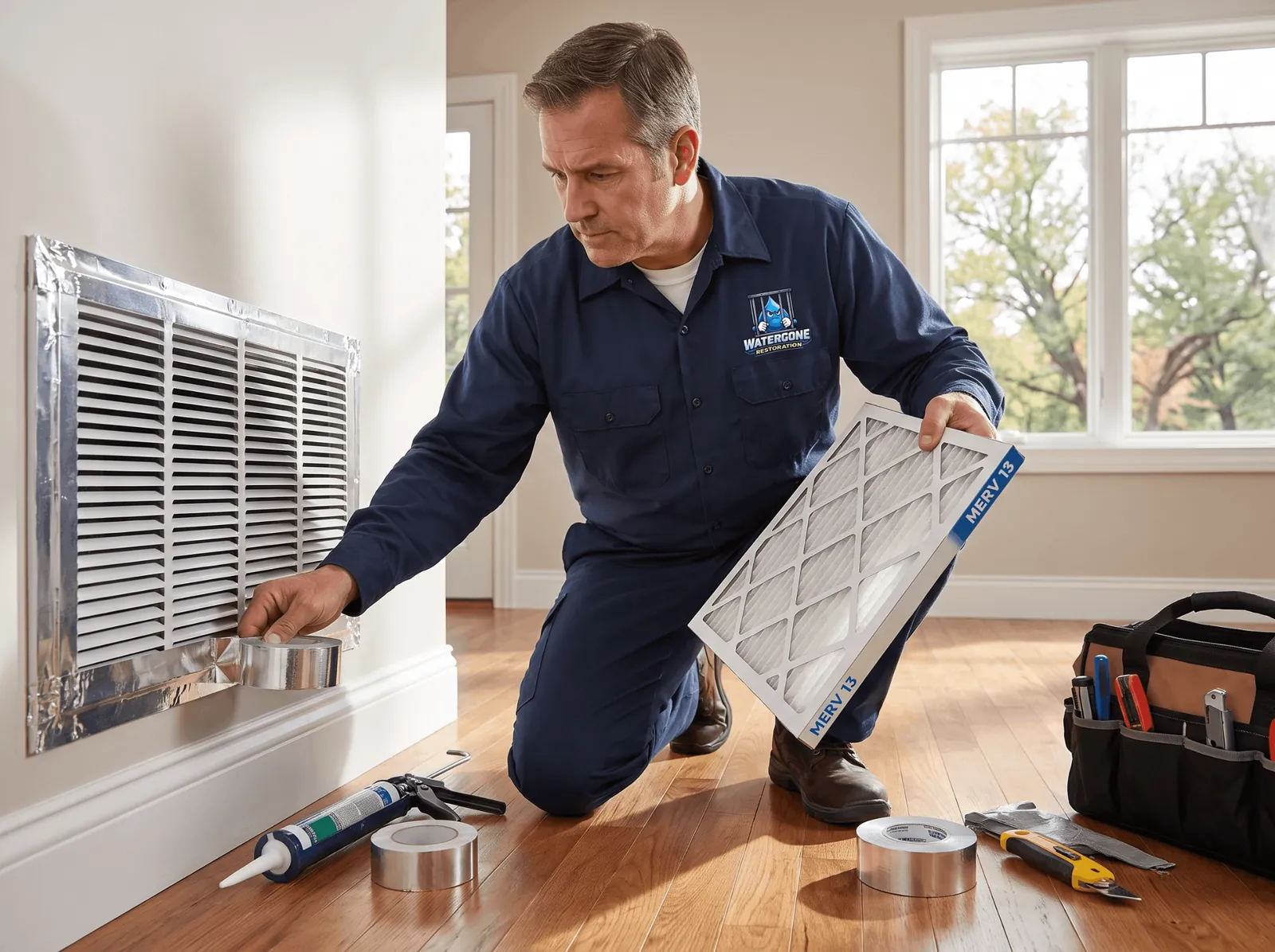
Because so much smoke enters through the air system, the HVAC setup is one of the most important lines of defense during fire season. A few targeted upgrades meaningfully reduce how much particulate gets in and circulates. Key measures include:
These steps reduce the smoke that gets in, but they cannot remove contamination that has already settled into ductwork and materials. When a home has taken on smoke, professional cleaning of the system and affected surfaces is what genuinely restores the indoor air.
For property managers responsible for apartment buildings, condos, or multiple rental homes, Santa Ana season carries an added layer of complexity. A single wind or smoke event can affect many units and many tenants at once, and the quality of the response depends heavily on planning done in advance. A clear emergency action plan is what turns a chaotic event into a managed one.
An effective plan establishes several things before the season: a defined chain of communication so tenants know how to report damage and where to get information, a pre-arranged relationship with a restoration company that can respond quickly to multiple units, and a documentation protocol so damage across the property is recorded consistently for insurance. It also includes practical preparation: ensuring roofs and exteriors across the property are sound, defensible space is maintained, and HVAC systems are ready, so that vulnerabilities are addressed before an event rather than discovered during one.
The value of this planning is speed and coordination when it counts. When a Santa Ana event causes damage across a property, having a restoration partner already in place, a documentation standard already defined, and a communication plan already understood means mitigation begins immediately rather than after days of scrambling. This is exactly the kind of coordinated, 24/7 response Water Gone Restoration provides, backed by the same insurance claim support that keeps multi-unit claims organized and moving.
Santa Ana events don't keep business hours, and damage across multiple units can't wait for a weekday callback. A round-the-clock response capability, with crews that can arrive fast and coordinate mitigation across many units at once, is what limits the total damage and keeps tenants safe. For property managers, having that response arranged in advance, rather than sourced mid-emergency, is the single biggest factor in how smoothly a fire-season event is handled.
Preparing thoroughly for Santa Ana season protects far more than any single part of a property. A comprehensive approach to wind, smoke, and fire readiness, paired with fast fire and smoke damage restoration when an event occurs, safeguards a home or property in several ways:
Santa Ana season is a fixture of fall in Orange County, but its damage is far from inevitable. With the right preparation and a fast, certified response ready when needed, homeowners and property managers can face the winds each year with confidence rather than dread.
📞 Call Water Gone Restoration at (949) 406-0287 for 24/7 fire, smoke, and wind damage response across Orange County.
Santa Ana winds typically occur from fall into winter, with the greatest fire danger concentrated in the fall, roughly September through November, when the landscape is at its driest after summer. These are the months when high pressure over the Great Basin most often drives hot, dry winds toward the coast, and when even a small ignition can become a fast-moving fire. Because the pattern recurs every year, treating fire-season preparation as an annual fall routine is the most reliable approach for Orange County property owners.
Yes. Wildfire smoke travels for miles on the wind, and its fine particulate can infiltrate homes far from the actual flames, even with windows closed. Air drawn into the home carries smoke particulate indoors, where it settles on surfaces and enters the HVAC system, leaving odor and contamination that linger after the outside air clears. Orange County communities have repeatedly experienced indoor smoke damage during regional fires miles away, which is why smoke protection and post-event cleaning matter even without a nearby blaze.
A MERV 13 or higher filter is widely recommended during fire season because it captures much more of the fine particulate in wildfire smoke than a standard low-MERV filter. Upgrading helps reduce how much smoke circulates through your home during an event. It's also important to replace the filter promptly afterward, since one loaded with smoke particulate will otherwise keep recirculating what it captured. Confirm your system is compatible with a higher-MERV filter, and pair it with sealing and recirculation strategies for the best protection.
The key is planning before the season. Establish a clear tenant communication chain for reporting damage, arrange a relationship with a restoration company that can respond to multiple units quickly, and define a consistent documentation protocol for insurance. Physically, ensure roofs and exteriors are sound, defensible space is maintained, and HVAC systems are ready across the property. Having a restoration partner and documentation standard already in place means mitigation starts immediately when an event hits, rather than after days of scrambling, which limits damage and protects both tenants and claims.
We answer 24/7. Give us your number and a short description of the damage, and an IICRC-certified technician will call you back to schedule a moisture assessment. If it is an emergency, calling is still the fastest route.
.png)
