.svg)
.svg)
.svg)
.svg)
.svg)
By the Water Gone Restoration team · IICRC-certified restoration, Orange County
July 7, 2026
By the Water Gone Restoration team · IICRC-certified restoration, Orange County
July 7, 2026

If you own a home in Orange County, fire season is no longer a distant summer worry that lives on the news. It is a local, calendar-driven reality that now stretches from roughly July through November, and the smart approach to fire season home preparation in Orange County starts long before the first red flag warning. The hills above Irvine, Yorba Linda, Anaheim, and the canyon communities of Silverado and Modjeska dry out through the summer, and a single Santa Ana wind event can turn that dry brush into a fast-moving threat. What surprises most homeowners is that your house does not need to be anywhere near flames to suffer serious, expensive damage.
A large share of the damage we document each fire season comes from smoke and ember exposure at homes that never caught fire at all. This guide walks you through the Orange County fire season timeline, the defensible space and home-hardening steps that actually protect a structure, how wildfire smoke contaminates a home from the inside, and what to do with your insurance documentation before an event ever happens.
For decades, Southern California treated fire season as a late-summer footnote. That framing no longer matches the data. Longer dry stretches, hotter summers, and delayed winter rains have extended the high-risk window so that meaningful fire-season preparation in Orange County needs to begin in early summer and hold through late fall. July and August dry out the fine fuels on our hillsides. September and October bring the Santa Ana winds that have driven nearly every catastrophic local fire in recent memory. November can stay dangerous until the first soaking rains finally arrive.
Orange County has lived this pattern directly. The 2017 Canyon Fire 2 tore through Anaheim Hills and Orange in October, and the 2020 Silverado and Bond fires forced mass evacuations across the eastern canyons during another bone-dry autumn. The lesson for every property owner is that the calendar has shifted. Treating fire preparedness as a year-round habit, rather than a two-week scramble when smoke appears on the horizon, is now the baseline for protecting an Orange County home.
Defensible space is the buffer you maintain between your structure and the surrounding vegetation, and in Orange County it is enforced by the Orange County Fire Authority (OCFA) under California’s Public Resources Code 4291. The state requires up to 100 feet of managed space around homes in fire-prone zones, organized into three concentric zones. Getting this right is one of the highest-value moves in any fire season home preparation plan for Orange County, because it slows an approaching fire and gives firefighters a safer place to defend your property.
OCFA offers free home assessments where an inspector walks your property, points out vegetation and hardening weaknesses, and hands you a personalized report — with no enforcement during the visit. If you live in a high or very high fire hazard severity zone, that free assessment is one of the smartest 20 minutes you can spend before fire season peaks.
Defensible space handles the ground around your house; home hardening handles the house itself. When a wildfire pushes embers a mile or more ahead of the flames, those embers search out the small, overlooked openings in a structure. Hardening your home means closing those gaps so a landing ember has nowhere to catch. These are the upgrades that matter most for Orange County properties:
You do not have to complete every upgrade at once. Hardening is cumulative — each vent screened and each foot of Zone 0 cleared measurably lowers the chance an ember turns into a house fire.

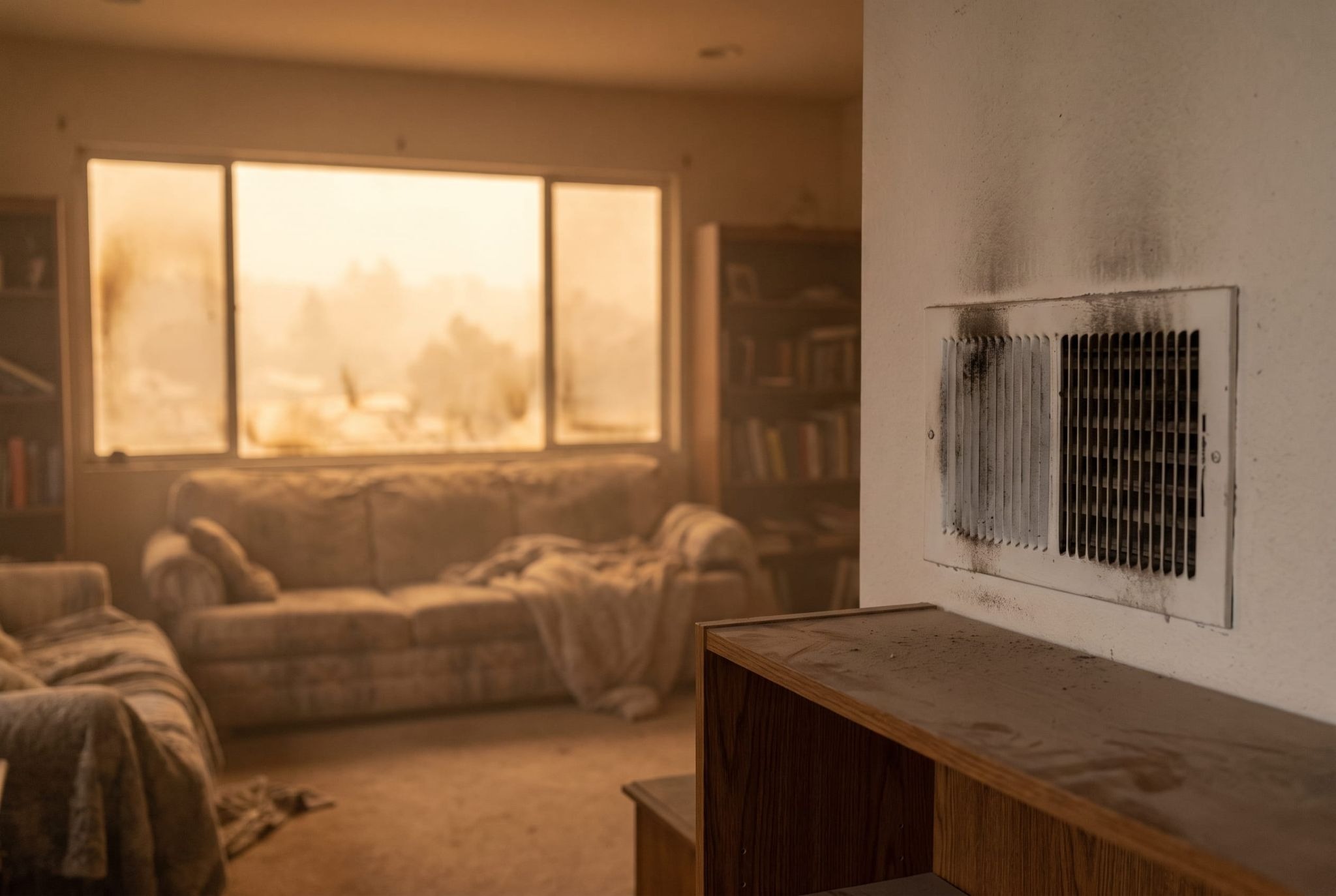
This is the part of fire season most Orange County homeowners underestimate. Even a home miles from the burn scar can take on extensive smoke and soot damage. During a wind-driven event, smoke and fine particulate travel far ahead of the fire and push into a house through attic vents, small structural openings, and — most importantly — the HVAC system. Once inside, smoke residue is acidic; it etches glass, corrodes metal, discolors paint, and embeds deep into porous materials like drywall, insulation, carpet, and upholstery.
Your air conditioner is the fastest path for wildfire smoke to contaminate an entire home. When the system runs during a smoke event, it pulls outdoor particulate through the return and distributes it into every room, coating the ductwork along the way. That is why a house can smell like smoke for months after the fire is out, and why simply masking the odor with air fresheners or ozone alone rarely solves it. Upgrading to a MERV 13 or higher filter and sealing HVAC intakes before a known wind event is a simple, effective defense.
Effective smoke and fire restoration in Orange County means neutralizing the contamination at the source — HEPA filtration, professional duct cleaning, and molecular-level odor treatment — not covering it up. If a smoke event does reach your home, professional fire and smoke restoration addresses the soot, the odor, and the ductwork together, so your indoor air is genuinely clean rather than just deodorized. Because suppression water and lingering moisture can trigger mold growth within 48 hours, a crew that handles both keeps the whole recovery under one roof.
California’s insurance landscape has changed dramatically, and fire-season preparation now includes getting your paperwork in order well before any emergency. Homeowners across the state have faced non-renewals and rising premiums, and many have been pushed onto the FAIR Plan as an insurer of last resort. Whatever policy you carry, the single best thing you can do is create a clear, timestamped record of your home and belongings today, while everything is intact.
When a fire or smoke loss does occur, that pre-event documentation becomes the backbone of a strong claim. It is exactly the kind of evidence adjusters need, and it is far harder to dispute a loss when the “before” picture is already on record.
When you call a professional restoration crew after a fire or smoke event, the first 72 hours are decisive. Smoke residue keeps damaging surfaces the longer it sits, and any water used in suppression starts breeding mold within 48 hours. A fast, coordinated response prevents a partial loss from becoming a total one. Here is what that response looks like in practice:
The 5-foot rule in California refers to Zone 0, the ember-resistant zone in the first five feet around your home. AB 3074 directed the state to create this zone, and the Board of Forestry rules setting the requirements were still being finalized as of September 2026. The intent is a perimeter kept clear of combustible materials such as bark mulch, firewood, dry plants, and wood fencing touching the structure. Confirm current requirements with OCFA or your local fire authority before relying on them.
Preparing for wildfires in California combines defensible space, home hardening, and a ready-to-go evacuation plan. Clear the required zones around your property, screen vents and seal gaps so embers cannot get inside, sign up for local alerts, and prepare a go-bag with important documents.
To prepare your home for a fire, work from the structure outward. Screen attic and eave vents with 1/8-inch mesh, keep the roof and gutters clear, and remove anything flammable within five feet of the walls. Upgrade siding and windows over time, then extend that care into your defensible space zones.
In most cases, yes — wildfire is a covered peril under virtually every standard California homeowners policy, including dwelling, contents, and living expenses. But the market has tightened, and many owners now rely on the FAIR Plan. Coverage varies, so review your policy and confirm details directly with your carrier before fire season.
Home hardening upgrades a house to resist embers, radiant heat, and flame — screening vents, installing a Class A roof, replacing combustible siding, sealing gaps, and using tempered glass. For the full breakdown and priority order, see the How to Harden Your Home Against Embers section above, which covers each upgrade in detail.
We answer 24/7. Give us your number and a short description of the damage, and an IICRC-certified technician will call you back to schedule a moisture assessment. If it is an emergency, calling is still the fastest route.
.png)
