.svg)
.svg)
.svg)
.svg)
.svg)
By the Water Gone Restoration team · IICRC-certified restoration, Orange County
September 11, 2026
By the Water Gone Restoration team · IICRC-certified restoration, Orange County
September 11, 2026
.png)
Few things are more frustrating than discovering mold in your home, filing a claim, and then watching your insurer deny it. If you have been through that, or you are worried it might happen to you, you are not alone — mold insurance claim denial in Orange County is one of the most common and most misunderstood problems homeowners face. The good news is that most denials are avoidable, because they usually come down to how the claim was documented and presented rather than whether the damage was real. Understanding why carriers say no is the first step to making sure they say yes.
With a mold claim, the paperwork decides the outcome more often than the extent of the growth does, which is why we treat every job as both a cleanup and an insurance claim from the moment we arrive. That dual focus exists precisely because we have seen how easily a legitimate claim gets denied when the paperwork is thin. In this guide we explain the gradual-leak exclusion that trips up so many homeowners, the "sudden and accidental" standard you need to meet, the documentation that strengthens your claim from day one, the role of moisture readings and timestamped photos, and when it makes sense to bring in a public adjuster.
The single biggest reason mold claims get denied in Orange County is the gradual-leak exclusion. Almost every standard homeowner policy draws a hard line between damage that happens suddenly and damage that develops slowly over time. A pipe that bursts without warning is a sudden event. A fitting that has been weeping a few drops a day for months, quietly feeding mold behind a cabinet, is gradual — and gradual damage is typically excluded. Carriers apply this exclusion aggressively, because it is the clearest way for them to decline a mold claim.
The tricky part is that mold, by its nature, takes time to grow, which can make even a sudden-origin problem look gradual if it is not documented properly. Insurers know this, and an adjuster reviewing an undocumented mold claim will often default to assuming the moisture was long-standing. That assumption is exactly what a well-built claim overcomes. The distinction between sudden and gradual is not just semantics — it is the entire basis on which your claim is approved or denied, which is why proving the origin of the water matters more than almost anything else.
To have a mold claim approved, you generally need to show that the mold resulted from a covered peril that was both sudden and accidental. In plain terms, something happened unexpectedly — a supply line failed, a water heater ruptured, an appliance hose let go, a storm drove water in — and the mold grew as a direct consequence of that event. When you can connect the mold to a specific, datable incident, you are squarely inside the coverage most policies provide.
Where homeowners run into trouble is the burden of proof. It is not enough to know the leak was sudden; you have to be able to demonstrate it. That means being able to point to when the event happened, what caused it, and how quickly the mold followed. This is why the response in the first hours after a water event is so important — catching it fast and documenting it thoroughly is what preserves the "sudden and accidental" evidence before mold has time to make the timeline murky. Proper water damage response and mold remediation, handled together and documented from the start, is what keeps that evidence intact.
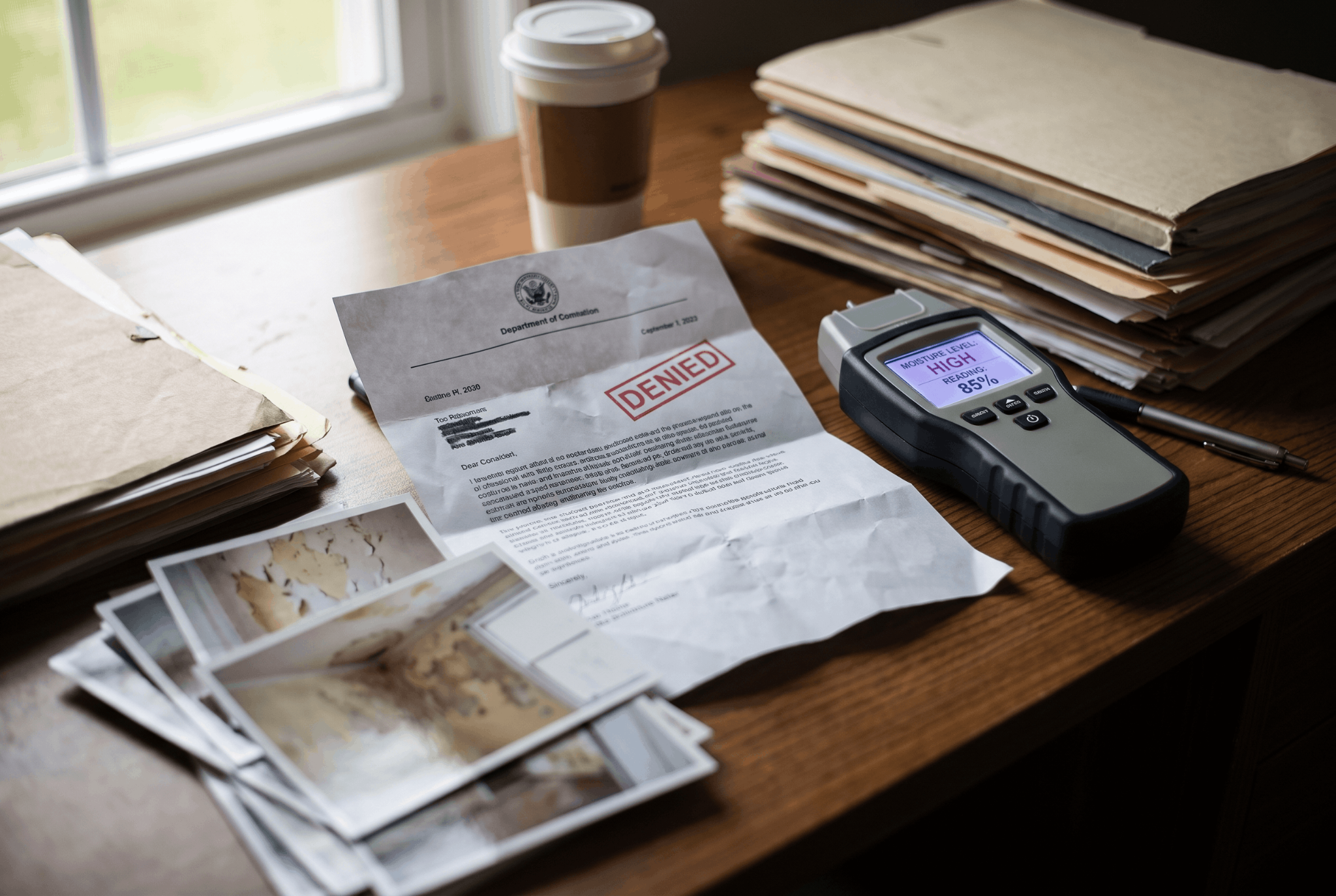
If there is one lesson from every denied claim we have seen, it is this: documentation is the difference between a claim that gets paid and one that gets denied. Adjusters approve what they can clearly see and verify, and they push back on what they cannot. The strongest mold claims are built from the very first moment the damage is discovered, before anything is cleaned up or torn out. Here is what belongs in that record:
The reason this works is simple: it removes the adjuster's ability to assume the worst. When the file already answers the questions a carrier would use to deny, there is far less room for a denial to take hold.
Two pieces of evidence carry disproportionate weight in a mold claim: moisture readings and timestamped photos. Together they establish the two things a carrier most wants to pin down — the extent of the water and the timeline of the event. Photos with a verifiable date and time create an undeniable record of the condition of your home at a specific moment, which is exactly what counters the argument that the damage developed slowly over months or years.
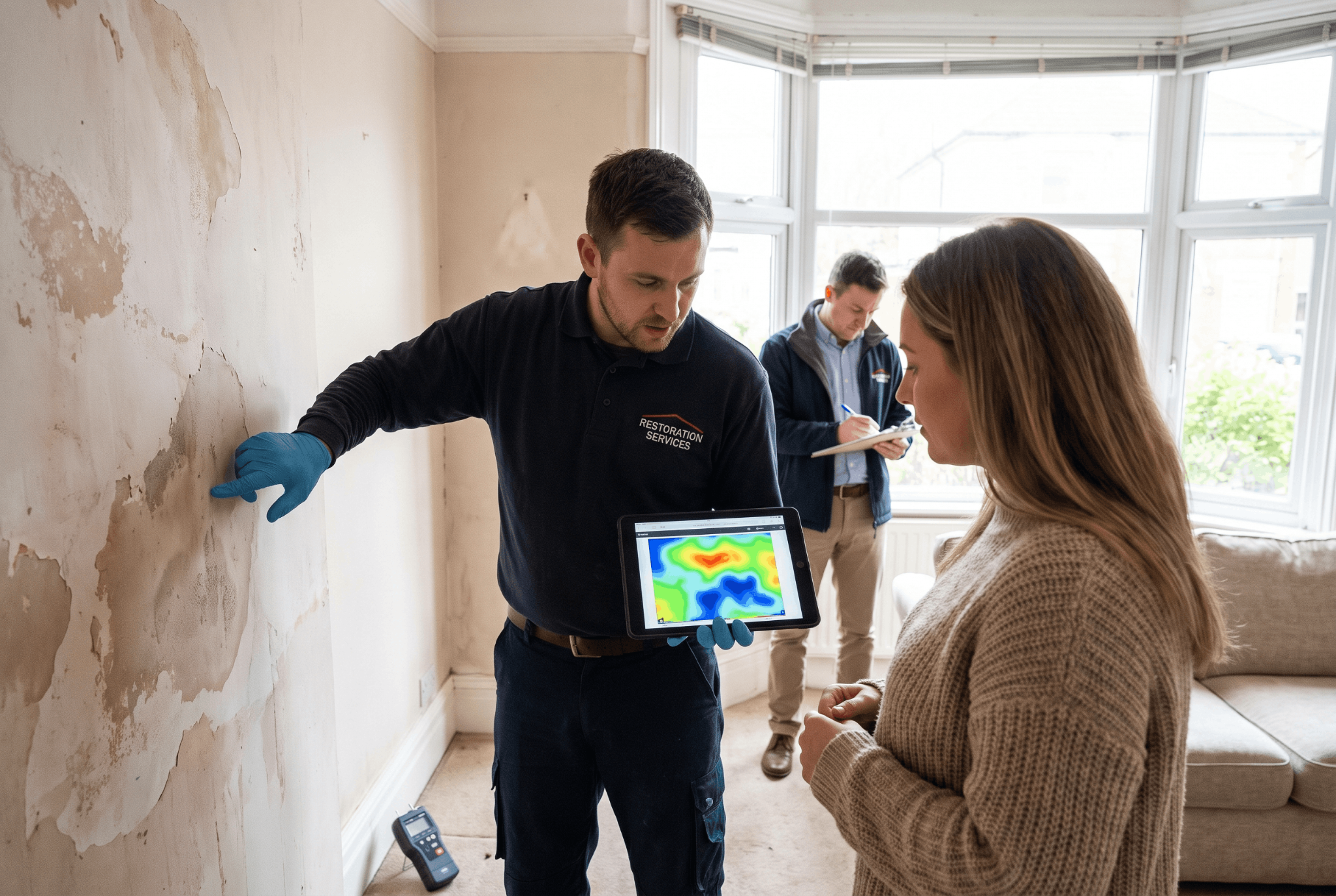
Moisture readings add the objective, measurable layer. A moisture meter shows precisely how saturated materials are and where hidden water has traveled, turning a subjective "it looks damp" into documented data an adjuster cannot easily dismiss. Taken daily during drying, these readings also prove the structure was dried properly, which protects you against a later dispute. This is precisely the kind of evidence a professional restoration crew captures as a matter of routine, and it is often the deciding factor between an approved claim and a denied one.
As you navigate a mold claim, you will hear about public adjusters, and it helps to understand how they differ from your restoration company. Your restoration vendor documents the loss, communicates with your carrier's adjuster, and builds the evidence that supports your claim — and a company that treats the job as a claim from day one handles most of what a straightforward loss requires. For many Orange County homeowners, that documentation and advocacy is enough to get a fair claim approved.
A public adjuster is a licensed professional you hire independently to represent your interests in the claim, and they typically charge a percentage of the settlement. They can be worth considering for large, complex, or already-denied claims — situations where the dollar amounts are significant and negotiation is contentious. For a clearly documented, straightforward mold claim, a public adjuster's fee may not be necessary. The practical approach is to start with strong documentation and a restoration partner who advocates for you, and to weigh a public adjuster if the claim is large, the carrier is disputing scope, or a denial has already landed and you need dedicated representation to appeal.
Putting it all together, avoiding a denial comes down to acting fast and building your case correctly from the start. Keep these principles in mind the moment you discover mold or a water event:
It also helps to know what the work itself is likely to run, so you can judge whether a carrier's offer actually covers the scope. Our guide to what drives mold remediation cost in Orange County breaks down the factors that move the number.
Because the difference between approval and denial so often lives in the documentation, having a partner who treats your mold remediation as an insurance claim from the first hour is the most reliable way to protect your coverage. We are a restoration company, not your insurer or an attorney, so we always recommend reviewing your specific policy terms with your carrier — but strong documentation benefits every claim, regardless of the fine print.
Yes, mold damage can often be claimed — but coverage depends on the cause. Most Orange County homeowner policies cover mold when it results from a sudden, accidental, and covered water event, such as a burst pipe or an appliance failure. Mold that grew gradually from a long-neglected leak or ongoing humidity is typically excluded. Many policies also cap mold coverage at a specific sublimit. The key to a successful claim is documenting that the mold stems from a sudden event, which is why fast response and thorough evidence matter so much.
Mold and water claims are most often denied for these reasons: (1) the damage is deemed gradual rather than sudden, falling under the maintenance exclusion; (2) incomplete or missing documentation of the loss; (3) the homeowner cleaned up or removed materials before they were recorded; (4) the cause could not be tied to a specific covered event; and (5) the claim exceeded a policy sublimit or the policy simply excluded that peril. Notably, most of these are about documentation and timing, which is exactly what a well-built claim addresses.
When speaking with an adjuster, stick to facts you can document and avoid speculating. Do not guess about how long a leak may have existed, since suggesting it was ongoing can trigger the gradual-damage exclusion. Avoid admitting you delayed addressing a known issue, and do not downplay or exaggerate the damage. It is also wise not to accept a settlement figure on the spot before the full scope is documented. The safest approach is to let the timestamped photos, moisture readings, and written scope speak for themselves rather than filling gaps with assumptions.
Start by documenting everything the moment you discover the problem — timestamped photos and video of the mold and its source, before any cleanup. Identify the cause and tie it to a specific event if you can. Then bring in an IICRC-certified restoration company that will take moisture readings, write an itemized scope, and communicate with your adjuster. Notify your insurer, submit the documentation, and keep damaged materials until they are recorded. A restoration partner that handles the claim alongside the cleanup makes this process far smoother and strengthens your odds of full approval.
It can, when the mold results from a covered, sudden water event and the claim is documented properly — but homeowners insurance will not cover mold caused by neglect, deferred maintenance, or long-term humidity. Coverage and any mold sublimit vary from policy to policy, so the outcome depends heavily on both your specific terms and how well the loss is presented. The most reliable way to have insurance take care of your mold is to respond quickly, prove the cause was sudden, and back the claim with professional documentation. Always confirm your specific coverage with your carrier.
We answer 24/7. Give us your number and a short description of the damage, and an IICRC-certified technician will call you back to schedule a moisture assessment. If it is an emergency, calling is still the fastest route.
.png)
