.svg)
.svg)
.svg)
.svg)
.svg)
By the Water Gone Restoration team · IICRC-certified restoration, Orange County
October 10, 2026
By the Water Gone Restoration team · IICRC-certified restoration, Orange County
October 10, 2026

When a water damage claim gets complicated, Orange County homeowners often hear two pieces of advice at once: hire a public adjuster, and let your restoration company handle the paperwork. That raises an obvious question, which one actually helps your claim, and do you need both? The two roles are easy to confuse because they overlap in one crucial area: getting you paid fairly. But they are different professions with different jobs, different ways of getting paid, and different points where they add value.
Understanding the distinction matters, because hiring the wrong help, or paying for help you didn't need, can cost you real money. A public adjuster takes a percentage of your settlement. A restoration company that documents thoroughly may make a public adjuster unnecessary in the first place. Knowing when each one earns their keep is the difference between a smart decision and an expensive assumption.
This guide breaks down both roles clearly: what a public adjuster does and how they’re paid, what a certified restoration company contributes to your claim, when you need one versus both, the math behind the typical public adjuster fee, and how the documentation handoff between the two actually works. At Water Gone Restoration, we handle the documentation and adjuster communication on every water damage restoration job, so this is a distinction we navigate with homeowners all the time.
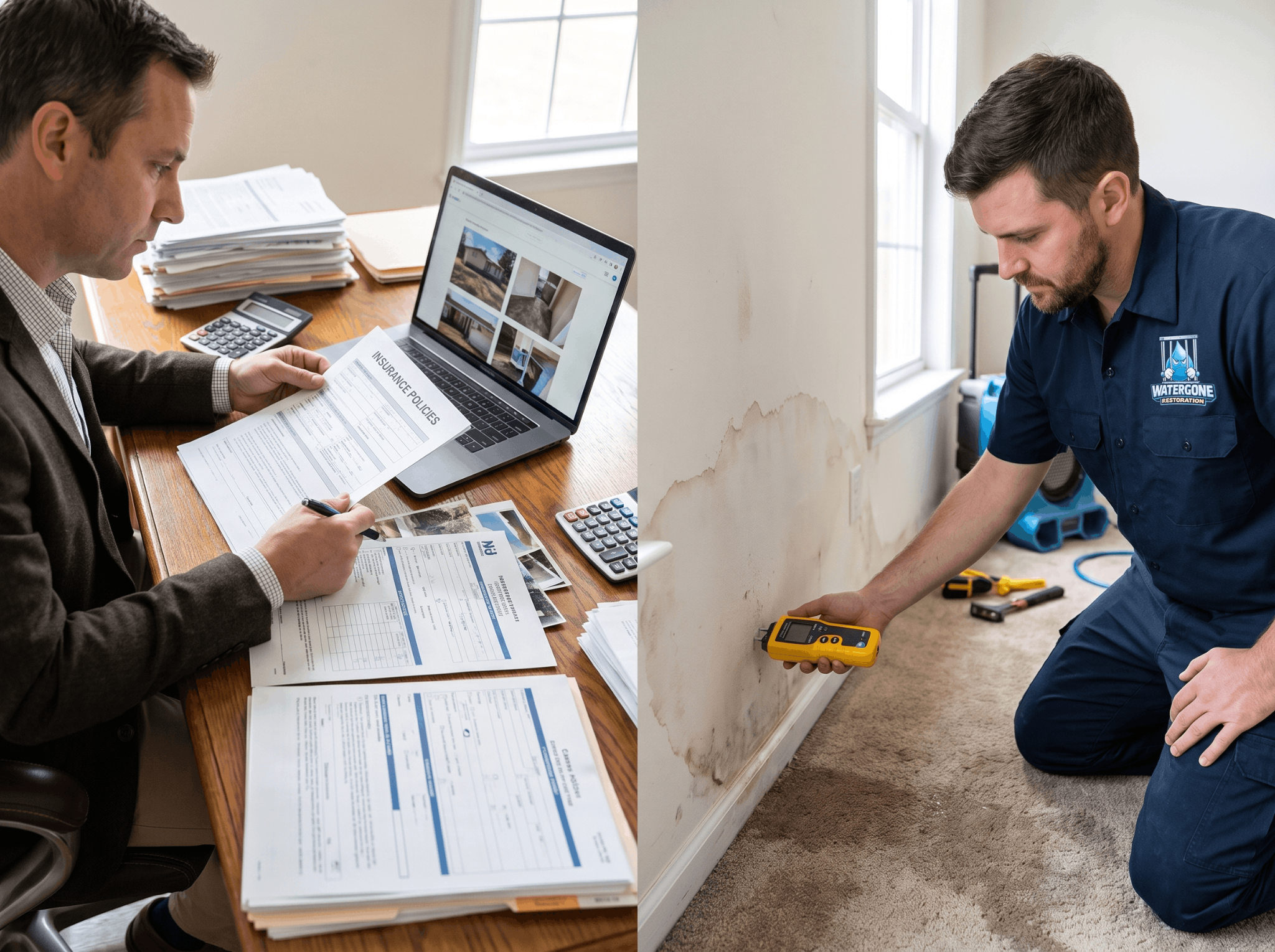
A public adjuster is a licensed insurance professional you hire to represent your interests in a claim. This is the key thing to understand: unlike the adjuster your insurance company sends, who works for the insurer, a public adjuster works for you. Their role is to assess your loss, prepare and file the claim, interpret your policy, and negotiate with the insurance company on your behalf to reach the highest justified settlement.
In practice, a public adjuster reviews your coverage, documents the damage, estimates the cost of the loss, and handles the back-and-forth with the carrier. They’re most often brought in on larger, more complex, or contested claims, situations where the dollar figures are significant and the homeowner wants a professional negotiator in their corner. For a homeowner who feels outmatched by the insurance process, that advocacy can be reassuring.
How they get paid is where homeowners need to pay close attention. Public adjusters typically work on contingency, taking a percentage of the final settlement, commonly in the range of 10 to 15 percent, though it varies by state, by claim size, and by agreement. That fee comes out of your payout. So while a public adjuster can increase a settlement, they also reduce what you ultimately keep, which is exactly why the decision to hire one deserves careful thought rather than a reflexive yes.
The single clearest way to think about a public adjuster is by contrast with the company adjuster. The insurance company’s adjuster is paid by, and answers to, the insurer, and their job is to assess the loss on the company’s behalf. A public adjuster flips that allegiance: they’re on your side of the table, paid by you, working to maximize rather than manage your payout. Whether that advocacy is worth its fee depends heavily on the specifics of your claim.
A restoration company’s primary job is to fix your home, extracting the water, drying the structure, and restoring the damage. But a good one does something else that directly shapes your claim: it documents the loss to insurance standards from the very first hour, and that documentation is often the foundation everything else is built on.
From the moment a certified crew arrives, they photograph and catalog every affected area before any work begins, take timestamped moisture readings, map the true extent of the damage including what’s hidden behind walls and under floors, and produce an itemized scope of loss written in the terms adjusters expect. This is the raw material of a claim. Whether or not a public adjuster is ever involved, this water damage restoration documentation is what proves the cause, the scope, and the severity of the loss.
There’s a reason this matters so much. Most claims that get denied or underpaid fail because of documentation gaps, not coverage disputes. A restoration company that builds a complete, professional file, and communicates directly with your adjuster to explain it, prevents most of those failures before they happen. In many cases this insurance claim support is enough to get a claim approved for the full cost of the work without any additional help, because there’s simply nothing left to dispute.

This is the question that actually matters, and the honest answer is that it depends on the claim. For the majority of straightforward water damage losses, a thorough, certified restoration company is enough on its own. When the cause is clearly a covered peril, the damage is well documented, and the carrier is behaving reasonably, the restoration company’s documentation and direct adjuster communication carry the claim to a full settlement without a public adjuster’s fee eating into it.
There are situations, though, where a public adjuster genuinely adds value. If a claim is very large or complex, if it’s been denied or badly underpaid despite solid documentation, if your policy language is genuinely in dispute, or if you’re simply overwhelmed and want a dedicated professional negotiator, a public adjuster’s advocacy can more than justify their fee. This holds whether the loss is a simple water event or something larger like major flood cleanup or a fire claim. The distinction isn’t restoration company or public adjuster as rivals; it’s matching the level of help to the difficulty of the claim.
The smartest move is often to start with a restoration company that documents relentlessly, then assess whether a public adjuster is needed based on how the claim actually unfolds. If you’re unsure where your claim stands, it’s worth a conversation — you can always reach out to our team to talk through it. If the file is airtight and the claim moves smoothly, you may never need a public adjuster. If it stalls despite strong evidence, you’ll be in a far better position to bring one in, because the documentation groundwork is already done.
The public adjuster fee deserves a clear-eyed look, because it’s where the decision often comes down to numbers. If a public adjuster charges, say, 10 to 15 percent of your settlement, the question is straightforward: will they increase your payout by more than their fee? If yes, they’ve paid for themselves. If no, you’ve given up a slice of a settlement you might have secured anyway.
Consider the logic on a hypothetical claim. If your loss would settle for a given amount with solid restoration documentation already in hand, a public adjuster only comes out ahead if they can push the settlement meaningfully higher, enough to cover their percentage and then leave you with more than you’d have kept on your own. On a claim that’s already well documented and being handled reasonably, that margin can be thin or nonexistent. On a claim that’s been wrongly denied or badly underpaid, the same fee can be a bargain, because the alternative is walking away with far less or nothing.
The variable that changes this math most is documentation. When a restoration company has already built a complete, professional file, much of the value a public adjuster would add, proving the scope and severity of the loss, is already captured. That’s why strong documentation from the outset doesn’t just help your claim; it also changes the calculus on whether paying a percentage to a public adjuster makes sense at all. The better your file, the less you may need to pay someone to fight for it.
When both professionals are involved, the relationship works best as a handoff rather than a turf war, and understanding how that handoff functions helps you get the most from each. The restoration company generates the technical evidence; the public adjuster uses it to negotiate. Each is doing what they do best.
In a well-run claim, the restoration company provides the photographic record, the moisture logs and drying documentation, and the itemized scope of loss. The public adjuster takes that body of evidence, combines it with their reading of your policy, and negotiates the settlement with the carrier. The stronger and more complete the restoration company’s documentation, the more effective the public adjuster can be, because they’re negotiating from a foundation of hard, timestamped facts rather than assertions.
This is also why the quality of your restoration company matters even if you do plan to hire a public adjuster. A company that documents to IICRC standards from the first hour hands the public adjuster a far stronger case than one that shows up, dries the home, and keeps sloppy records. At Water Gone Restoration, the work is owner-led and documentation-first precisely because that record is what protects the homeowner, whether they end up negotiating the claim themselves, leaning on our direct adjuster communication, or bringing in a public adjuster for a complex fight. The same standard applies across every loss we handle, from water and mold remediation to fire and smoke restoration.
📞 Dealing with a water damage claim in Orange County? Call Water Gone Restoration at (949) 406-0287 for 24/7 response and the thorough, insurance-ready documentation that strengthens your claim from day one.
The adjuster your insurance company sends works for the insurer and assesses the loss on the company’s behalf. A public adjuster is one you hire to represent your interests, working for you to prepare, file, and negotiate the claim toward the highest justified settlement. The key difference is allegiance: the company adjuster answers to the insurer, while the public adjuster is on your side of the table, paid by you.
Public adjusters typically work on contingency, taking a percentage of the final settlement, commonly in the range of 10 to 15 percent, though it varies by state, claim size, and agreement. That fee comes out of your payout, so while a public adjuster can increase a settlement, they also reduce what you ultimately keep. Whether that trade-off is worth it depends on how much they can realistically increase your specific claim.
Often, no. For most straightforward water damage claims, a certified restoration company that documents thoroughly and communicates directly with your adjuster is enough to secure a full settlement without a public adjuster’s fee. A public adjuster adds the most value on large, complex, denied, or underpaid claims, or when your policy is genuinely in dispute. A good approach is to start with strong restoration documentation and assess whether a public adjuster is needed based on how the claim unfolds.
They divide the work by expertise. The restoration company generates the technical evidence, photos, moisture logs, drying documentation, and an itemized scope of loss, while the public adjuster uses that evidence, combined with their reading of your policy, to negotiate the settlement. The stronger the restoration company’s documentation, the more effective the public adjuster can be, because they’re negotiating from timestamped facts rather than assertions.
Consider a public adjuster when the claim is large or contested, when it’s already been denied or clearly underpaid despite good documentation, when your policy language is in genuine dispute, or when you simply feel overwhelmed and want a dedicated negotiator. For a well-documented, clearly covered loss that the carrier is handling reasonably, a thorough restoration company with direct adjuster communication is often all you need. Start with strong documentation, then decide based on how the claim actually progresses.
We answer 24/7. Give us your number and a short description of the damage, and an IICRC-certified technician will call you back to schedule a moisture assessment. If it is an emergency, calling is still the fastest route.
.png)
