.svg)
.svg)
.svg)
.svg)
.svg)

By the Water Gone Restoration team · IICRC-certified restoration, Orange County
September 11, 2026
By the Water Gone Restoration team · IICRC-certified restoration, Orange County
September 11, 2026

If you live within a few miles of the water in Orange County, you already know summer here feels different than it looks. The skies are clear, no pipe has burst, and yet the bathroom mirror stays foggy long after a shower and a faint musty smell drifts out of the hall closet. That combination of a dry forecast and a damp-feeling home is exactly where summer humidity mold prevention in Orange County becomes a real concern. Mold does not need a flood to take hold. It only needs moisture in the air, and along the coast that moisture is in steady supply from June through September.
At Water Gone Restoration, we respond to leak emergencies across Orange County in 60 minutes, but a large share of the mold we find never started with a leak at all. It started with months of elevated indoor humidity that nobody measured. This guide explains the science behind that, why coastal homes are especially exposed, and the practical steps you can take this season to keep your home dry.
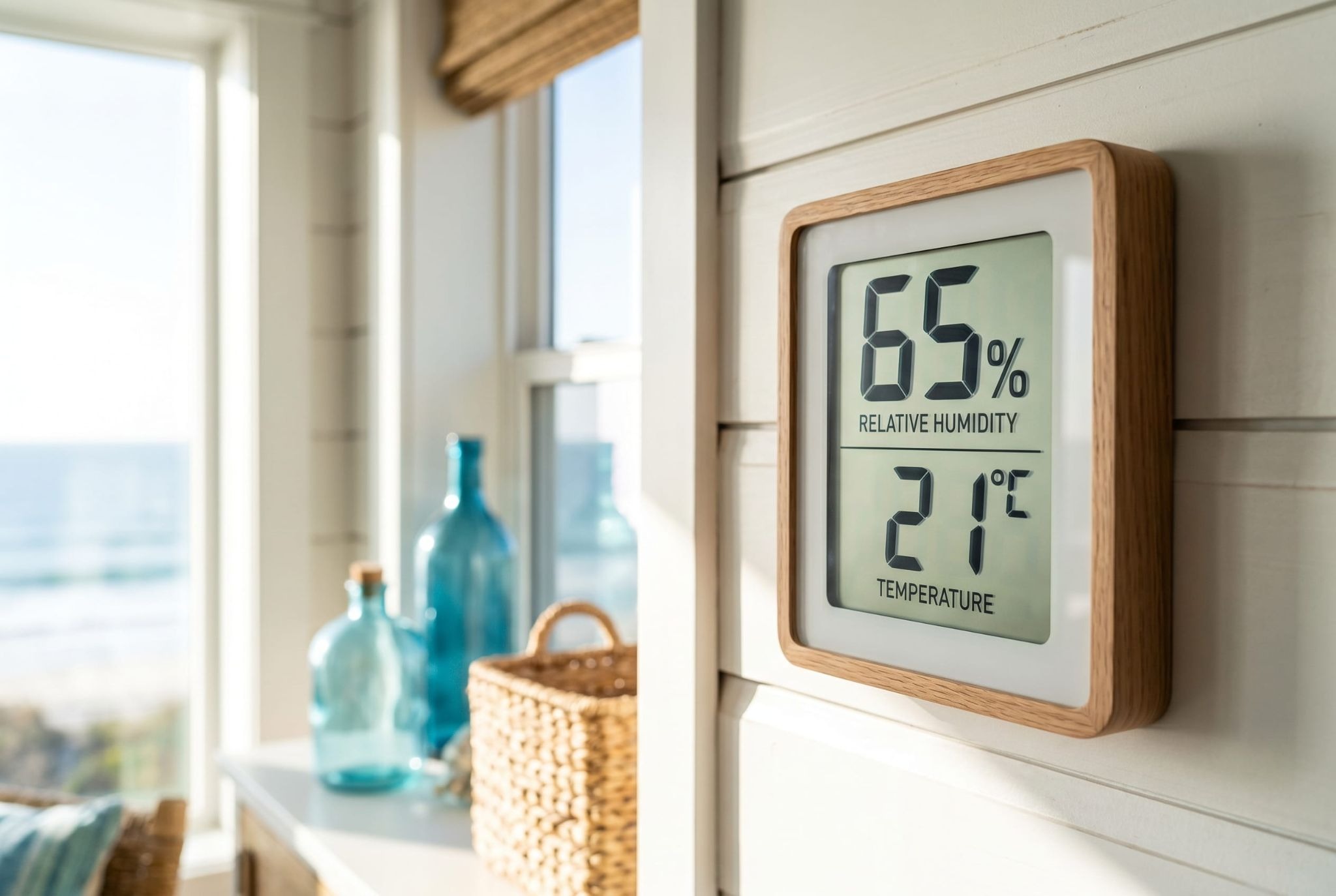
Mold spores are everywhere in the air, indoors and out. They cannot do anything, though, until they find moisture. The single most useful number for summer humidity mold prevention in Orange County is 60% relative humidity. Below that level, most household mold species struggle to germinate on surfaces. Once indoor air sits at or above 60% for extended periods, the moisture content of drywall, wood trim, fabric, and grout climbs high enough for colonies to start.
The reason is that materials in your home constantly exchange moisture with the air around them. Hold a room at 65% humidity for a week and the surfaces eventually carry enough dampness to support growth, even though you never see a drop of standing water. This is why the air itself, not just plumbing, deserves your attention in summer.
Newport Beach, Huntington Beach, and Laguna Beach share a marine climate that keeps outdoor humidity high through the warm season. Cool ocean water meets warmer air, and the result is the famous "May Gray" and "June Gloom," along with heavy overnight marine layers that linger well into summer mornings. During those stretches, outdoor humidity near the coast frequently sits in the 70% to 90% range, especially overnight and at dawn.
Every time a door opens, that damp air comes inside. Homes near the beach also tend to be older, with original windows and less aggressive ventilation, so the moisture that enters has nowhere to go. The practical takeaway for controlling summer humidity is that coastal homes can drift above the 60% indoor threshold for weeks at a time without anyone noticing, because the air feels pleasant even when it is dangerously damp for your drywall.
One of the clearest warning signs is condensation on the inside of your windows in the morning. When humid indoor air meets a cooler glass surface overnight, water beads on the pane. If you are wiping down windowsills on summer mornings, your indoor humidity is almost certainly too high, and that is the moment to act rather than wait for visible mold to appear.
That morning condensation is really a visible dew point for mold growth in action: whenever the dew point of your indoor air rises close to the temperature of a window, wall, or duct, water condenses out onto that surface. Tracking dew point alongside relative humidity gives you an earlier warning than watching humidity alone, since a home can have a high dew point even when the percentage reading looks tolerable. Temperature matters too. Most household mold species can germinate anywhere from roughly 40°F to 100°F, and they are most comfortable between 60°F and 80°F, which happens to be the range most Orange County homes are kept at during summer. That means there is no single best temperature to prevent mold on its own; keeping rooms cooler helps only marginally, and controlling humidity below 60% is still what actually stops growth.

Orange County is not one climate. Move ten or fifteen miles inland to cities like Anaheim, Orange, or Irvine and the humidity pattern changes. Inland summers are hotter and drier during the day, often dropping well below 60% relative humidity in the afternoon heat. That sounds protective, and during daylight hours it usually is.
The catch inland is air conditioning. Homes run their AC hard, and poorly balanced systems, oversized units that cycle off too quickly, or condensation around ductwork can create damp pockets even in a dry climate. So coastal homes battle constant ambient moisture, while inland homes more often face localized dampness from cooling systems and overnight humidity rebounds. Effectively preventing coastal mold in Orange County means knowing which pattern applies to your specific neighborhood rather than assuming a dry region is automatically safe.
Your bathrooms and laundry room produce more moisture than any other spot in the house. A single hot shower can release several cups of water into the air, and a builder-grade fan often is not strong enough to clear it before it settles into walls and ceilings. Right-sizing these fans is one of the highest-value moves you can make this summer. Use these specs as a starting point:
Running the fan during a shower and for at least 20 minutes afterward, in both bathrooms and the laundry area, keeps a surprising amount of moisture out of your home's structure.
Portable dehumidifiers are fine for a single damp room, but coastal homeowners often find themselves emptying the tank twice a day and still losing the battle. When elevated humidity is a whole-house, all-summer condition rather than a one-room issue, a whole-home dehumidifier integrated with your HVAC system is worth serious consideration.
These systems condition the air throughout the house and hold it below the 60% threshold automatically, draining continuously so there is no tank to empty. They make the most sense if you live close to the coast, notice musty odors in multiple rooms, see condensation on windows across the home, or have already dealt with mold once and want to prevent a repeat. If you have had a previous moisture event, professional mold remediation combined with a dehumidification plan gives you the cleanup and the long-term protection together. The same logic applies after any water damage event, where controlling humidity during drying is what prevents secondary mold growth.
You cannot manage what you do not measure, and the good news is that monitoring indoor humidity is inexpensive and easy. A few affordable tools let you catch problems long before they become visible mold:
If your readings consistently sit above 60% no matter what you try, that is your signal that the moisture load has outgrown DIY fixes and it is time to bring in a professional assessment.
Yes, 70% indoor humidity is too high and puts your home in active mold-risk territory. Once air sits above 60% for extended periods, drywall, wood, and fabric absorb enough moisture to support growth. At 70%, that process accelerates and you may also notice condensation, musty odors, and a clammy feel. Coastal Orange County homes drift into this range easily during summer marine layers, which is why measuring and lowering it matters so much near the water.
Start by measuring indoor humidity with a hygrometer and keeping it below 60%. Run properly sized bathroom and laundry exhaust fans during and after moisture-heavy activities, and vent them fully outdoors. Use a portable dehumidifier in damp rooms, or a whole-home unit if the dampness is widespread. Fix small leaks quickly and improve airflow in closets and corners. These habits are the backbone of summer humidity mold prevention in Orange County during the muggiest stretches.
The ideal indoor range for stopping mold is 30% to 50% relative humidity, with 60% as the hard ceiling you never want to cross for long. Staying within this band keeps surfaces too dry for spores to take hold while remaining comfortable for people and easy on wood furniture. In humid coastal climates, holding the lower end of that range may require a dehumidifier, but the payoff is a home that resists mold even through a damp Orange County summer.
Yes, but only as a side effect, and not reliably enough to count on. Air conditioning pulls some moisture out as warm air passes over the cold evaporator coil, which is why a house often feels less clammy with the system running. The catch is that a unit sized for temperature will satisfy the thermostat and shut off before it has removed much moisture, and an oversized unit does this fastest of all. On a mild, damp coastal morning the AC may barely run at all while outdoor humidity sits at its highest. If your hygrometer still reads above 60% with the AC on, the cooling system is not solving the moisture problem and you need dedicated dehumidification.
In coastal Orange County, summer is the peak season, roughly June through September, when marine layer humidity keeps outdoor air in the 70% to 90% range for weeks at a time. Inland neighborhoods see a second risk window in late winter and early spring, when rain events and cooler temperatures slow drying and AC systems sit idle. Either way, the trigger is the same: indoor air holding at or above 60% relative humidity for an extended stretch, which is why year-round monitoring matters more than watching the calendar alone.
No. Lowering humidity stops mold spreading further and is essential to keeping it from coming back, but it does not remove what has already grown. Dried mold is dormant rather than gone, and it becomes active again as soon as moisture returns. Existing growth has to be physically removed and the affected materials cleaned or replaced, which is what remediation to standard involves. Treat a dehumidifier as the thing that protects the repair, not as the repair itself.
We answer 24/7. Give us your number and a short description of the damage, and an IICRC-certified technician will call you back to schedule a moisture assessment. If it is an emergency, calling is still the fastest route.
.png)
