.svg)
.svg)
.svg)
.svg)
.svg)
By the Water Gone Restoration team · IICRC-certified restoration, Orange County
September 11, 2026
By the Water Gone Restoration team · IICRC-certified restoration, Orange County
September 11, 2026

Most homeowners never set foot in their attic from one year to the next. It is dark, hot, and out of sight, which is exactly why attic moisture damage in Orange County so often goes undetected until it becomes expensive. While you keep the living space cool and comfortable downstairs, the space directly above your ceiling can be quietly battling humidity, condensation, and the early stages of mold. By the time the evidence reaches your finished rooms, the problem upstairs has usually been developing for months.
This is an under-discussed issue, partly because the causes are hidden in construction details most people never think about: where a bathroom fan actually vents, whether the roof can breathe, and how the attic exchanges air with the outdoors. This post pulls those details into the open. Understanding them is the key to catching attic moisture early and protecting both your roof structure and the air your family breathes.
It seems backward at first. You run the air conditioning, the house feels crisp and comfortable, yet the attic above is damp. The reason is that your attic is a separate climate zone from your conditioned living space, and it follows different rules. Down below, your HVAC system removes heat and humidity. Up top, the attic is exposed to outdoor conditions and to moisture rising from inside the home.
Orange County's coastal-influenced climate — felt as strongly in Huntington Beach as it is inland in Irvine and Santa Ana — keeps outdoor humidity high for much of the year, especially overnight and during the marine-layer months. Warm, moist air finds its way into the attic, meets cooler surfaces like the underside of the roof at night, and condenses into water. Add the moisture that escapes upward from daily living, showers, cooking, and laundry, and you have a space that stays damp even while your thermostat says everything is fine. This disconnect is the root of most attic moisture damage in Orange County homes.
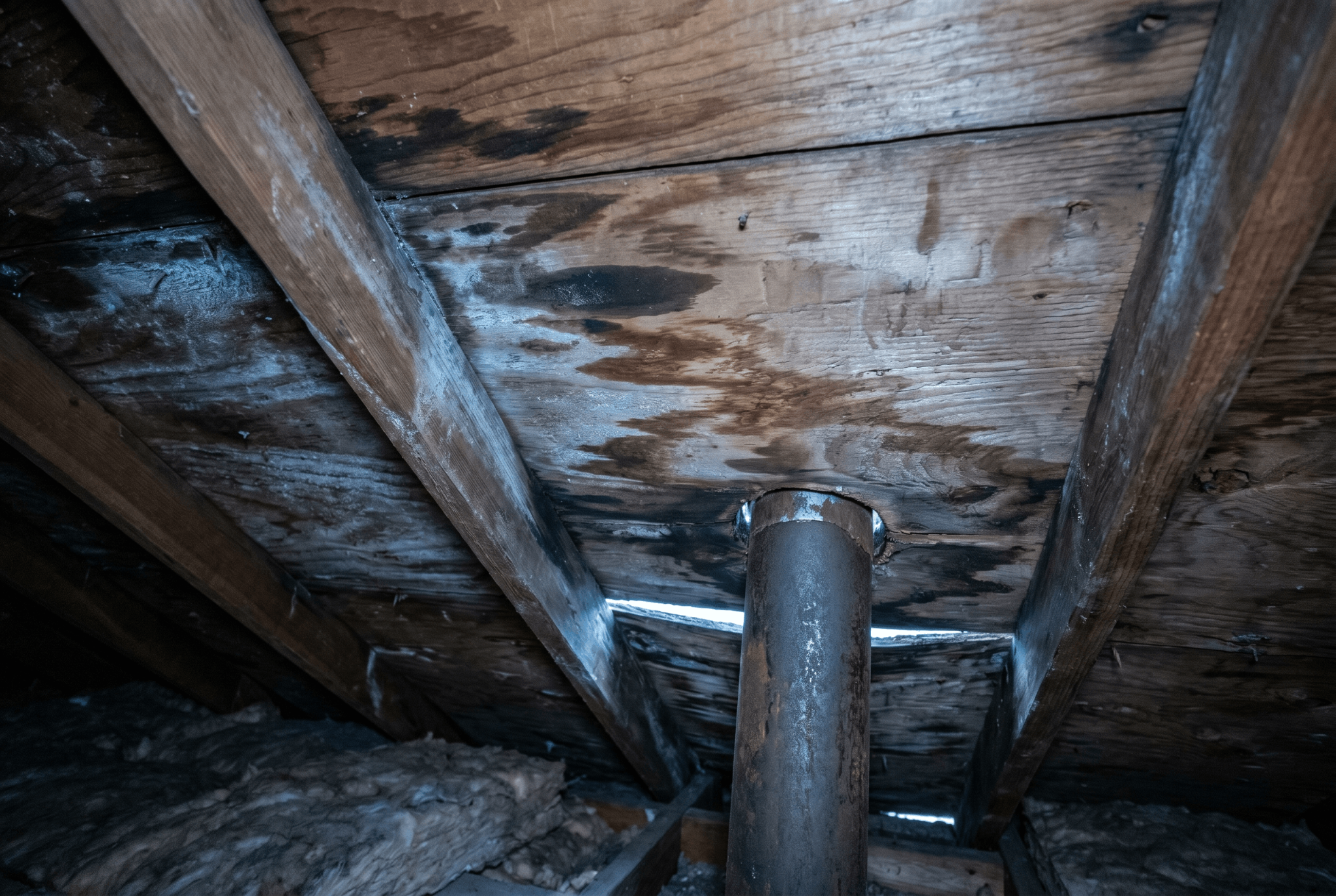
Here is one of the most common and most damaging mistakes hiding above Orange County ceilings. A bathroom exhaust fan is supposed to carry humid air all the way outside through a dedicated duct. In a surprising number of homes, that duct simply ends in the attic, dumping warm, moisture-laden shower air directly onto the roof framing and insulation.
This is more than a bad idea. Under the California Mechanical Code, bathroom exhaust fans are required to terminate outdoors, precisely because venting into an attic floods it with humidity day after day. Every hot shower sends another surge of moisture into a confined, poorly ventilated space, where it condenses on cold surfaces and soaks into wood and insulation. If you have ever wondered how an attic gets wet with no roof leak in sight, a misrouted bathroom fan is one of the first culprits we check when investigating attic moisture damage in Orange County properties.
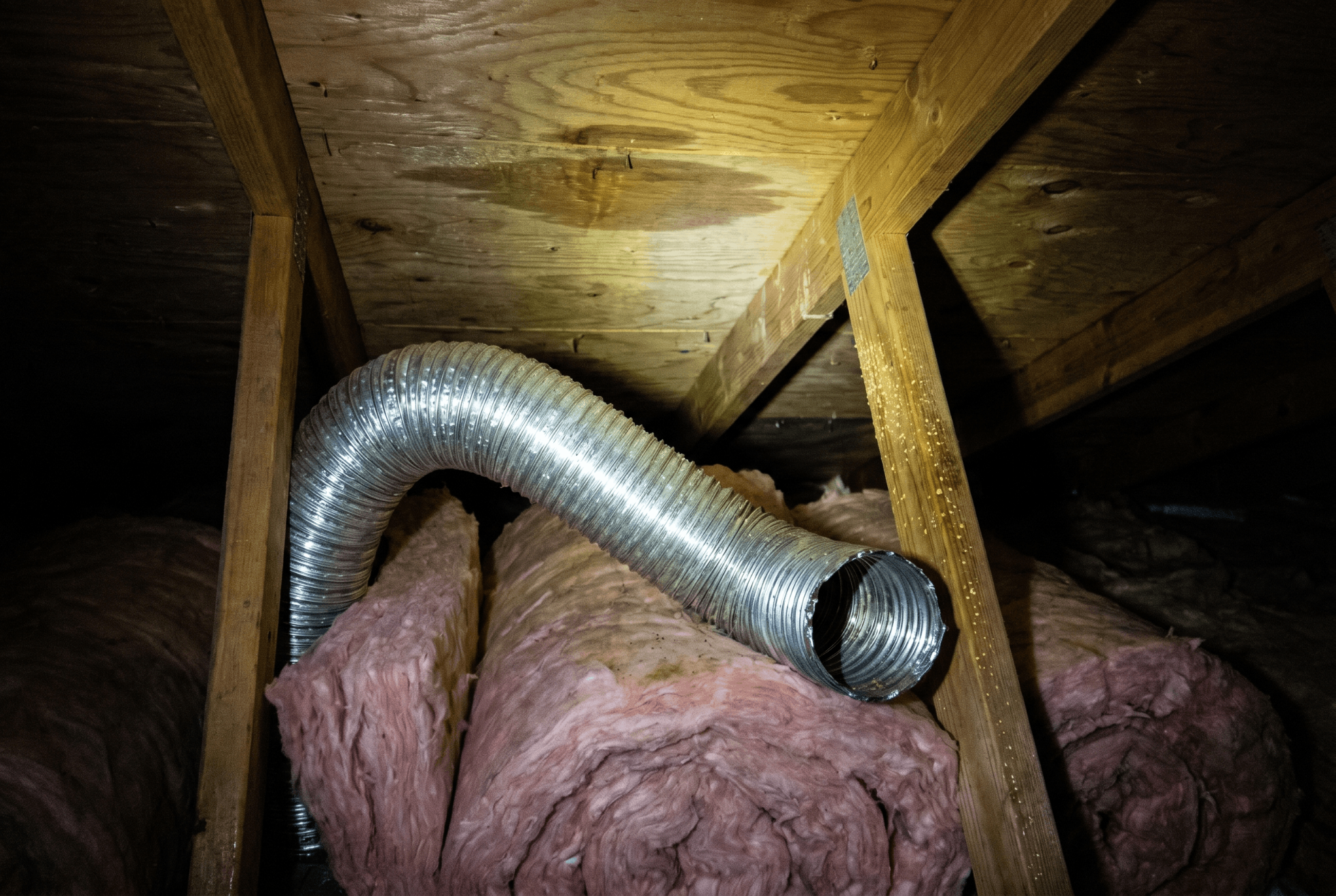
From the attic, trace the flexible duct connected to each bathroom fan housing. It should connect to a roof cap or a wall vent that leads outside. If the duct just lies loose, points into open insulation, or is disconnected entirely, your fan is venting into the attic. This is a fixable problem, but until it is corrected, no amount of attic ventilation will fully solve the dampness.
A healthy attic breathes. Cool, dry air enters low through soffit vents under the eaves, rises as it warms, and exits high through ridge or roof vents, carrying heat and moisture out with it. This continuous airflow is what keeps an attic dry. When the system is unbalanced, that flow stalls and humidity lingers.
In many Orange County tract homes, the balance is off. Soffit vents get blocked by insulation pushed against the eaves during installation, or by paint and debris over the years. Sometimes there are too few intake vents to match the exhaust vents up top, or vice versa. Without balanced intake and exhaust, the attic cannot flush out the moist air, and condensation builds on the sheathing. Correcting these imbalances is often a central part of resolving attic moisture damage, because ventilation is the attic's natural defense against humidity.
You do not have to climb into the attic to catch a developing problem. Several inadequate attic ventilation symptoms show up in your everyday living space if you know what to watch for:
Any one of these signs is reason enough to have the attic inspected before the damage spreads further into the structure.
This is where attic dampness becomes a whole-home air quality issue. In most Orange County homes, the HVAC ductwork and often the air handler itself run through the attic. When that space is humid and harboring mold, the ducts are sitting right in the middle of it.
Mold spores from damp attic surfaces settle on and inside the ductwork. Then, every time your system runs, it can pull those spores into the airstream and distribute them throughout your living space, room by room. So an attic problem you cannot see becomes air you breathe all day. Resolving it usually means addressing both the moisture source and the contamination together, which is why professional mold remediation for contaminated ductwork and proper drying of the affected materials go hand in hand. The same conditions that damage your roof structure can quietly degrade your indoor air, making prompt attention to attic moisture damage important for health as well as for the home itself.
Fixing a damp attic is rarely a single repair. It is a sequence that addresses the source, the existing moisture, and the resulting damage in the right order. Here is how the process typically works:
As an IICRC-certified restoration team, Water Gone Restoration handles this full sequence, using thermal imaging and moisture meters to find hidden dampness and documenting the work for your insurance claim. Pairing remediation with full water damage restoration in Orange County ensures the attic is both dry and structurally sound when the job is finished.
Fixing attic moisture starts with finding and stopping the source, whether that is a bathroom fan venting into the attic, blocked soffit vents, or a roof leak. Next, the space is dried thoroughly with professional equipment, and any mold is remediated. Finally, ventilation and insulation are corrected so air can flow properly and stay dry. Because these steps build on each other, skipping the source repair almost always lets the problem return, which is why a complete approach matters most.
Attic ambering, the yellow or amber discoloration and sticky residue that can appear on insulation and framing, is generally a warning sign worth investigating. It often points to a combination of heat, off-gassing, and moisture or poor ventilation in the attic. While the staining itself may be cosmetic, the underlying conditions that cause it, trapped humidity and stagnant air, are the same ones that lead to wood damage and mold. Treat ambering as a prompt to check your attic's ventilation and moisture levels.
Drying a wet attic safely requires more than opening a vent. Professionals use commercial air movers and dehumidifiers to pull moisture from saturated insulation and sheathing, monitoring progress with moisture meters until materials reach safe levels. Severely soaked insulation often has to be removed and replaced. Crucially, the moisture source must be corrected first, because drying an attic that is still taking on humidity is a losing battle. Done properly, the structure is returned to a stable, dry condition.
Yes, an attic can be dehumidified, and in humid coastal climates it is sometimes part of the solution. A dehumidifier can lower moisture during active drying or in problem attics that stay damp. However, dehumidification works best alongside proper ventilation rather than as a substitute for it. The most durable fix is balanced soffit and ridge airflow plus eliminating moisture sources, with a dehumidifier used as support where a space remains stubbornly humid despite good ventilation.
Usually not, when the cause is gradual. Most Orange County policies cover water damage that is sudden and accidental, such as a roof failure during a storm or a supply line bursting in the attic, and exclude damage that built up over seasons from a misrouted bath fan or blocked vents. That distinction is settled by documentation, so where there is any chance of a sudden cause we photograph and log it before anything is disturbed. Confirm your own coverage with your carrier.
We answer 24/7. Give us your number and a short description of the damage, and an IICRC-certified technician will call you back to schedule a moisture assessment. If it is an emergency, calling is still the fastest route.
.png)
