.svg)
.svg)
.svg)
.svg)
.svg)
By the Water Gone Restoration team · IICRC-certified restoration, Orange County
September 11, 2026
By the Water Gone Restoration team · IICRC-certified restoration, Orange County
September 11, 2026

Right now, while your air conditioner hums through another warm Orange County afternoon, it is quietly producing water. A lot of it. And in far too many homes, that water is going somewhere it should not. AC condensate leak water damage in Irvine is one of the most common and most overlooked sources of ceiling and drywall ruin we see all summer long. There is no burst pipe and no storm to blame, just a slow drip from an attic air handler that nobody thought to check until a brown stain appeared overhead.
The frustrating part is how preventable it is. Your cooling system pulls humidity out of the air and turns it into condensation that is supposed to drain safely outside. When that drain clogs, the water has to go somewhere, and in a two-story Irvine tract home that somewhere is usually your ceiling. This guide breaks down exactly how it happens, what to look for, and when a water stain means it is time to call a restoration professional rather than your HVAC tech.
Every central air conditioner removes moisture from your indoor air as it cools. That moisture collects in a drain pan beneath the evaporator coil and exits through a condensate drain line, a narrow PVC pipe that carries the water outdoors. On a hot, humid day, a single system can produce 5 to 20 gallons of condensate. That is a steady stream of water relying on one small pipe staying clear.
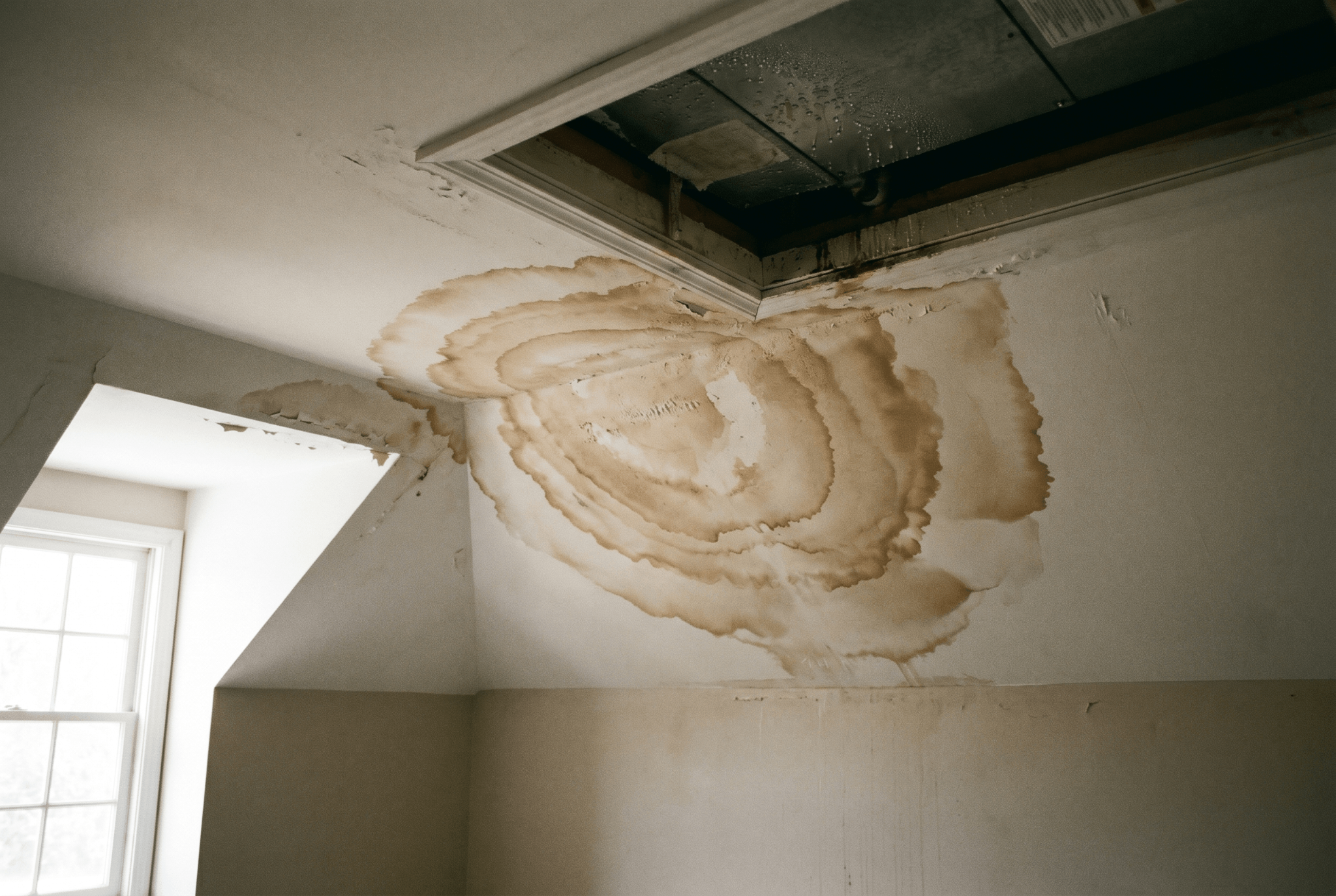
Over time, algae, dust, and slime build up inside that line until it clogs. With nowhere to drain, water backs up and overflows the pan. From an attic or closet air handler, it then soaks into the ceiling drywall below. Drywall acts like a sponge, so the damage spreads outward from the source, sagging, staining, and eventually crumbling. By the time most homeowners notice the discoloration, the material above has already been wet for days. This slow, hidden progression is what makes AC condensate leak water damage so costly in Irvine homes, and why it often requires the same professional water damage response as a burst pipe or appliance failure.
Many of the tract homes built across Irvine and Tustin place the air handler in the attic to save living space. It is an efficient design, but it means the wettest component of your cooling system sits directly above your finished ceilings and bedrooms. When the condensate system fails up there, gravity does the rest.
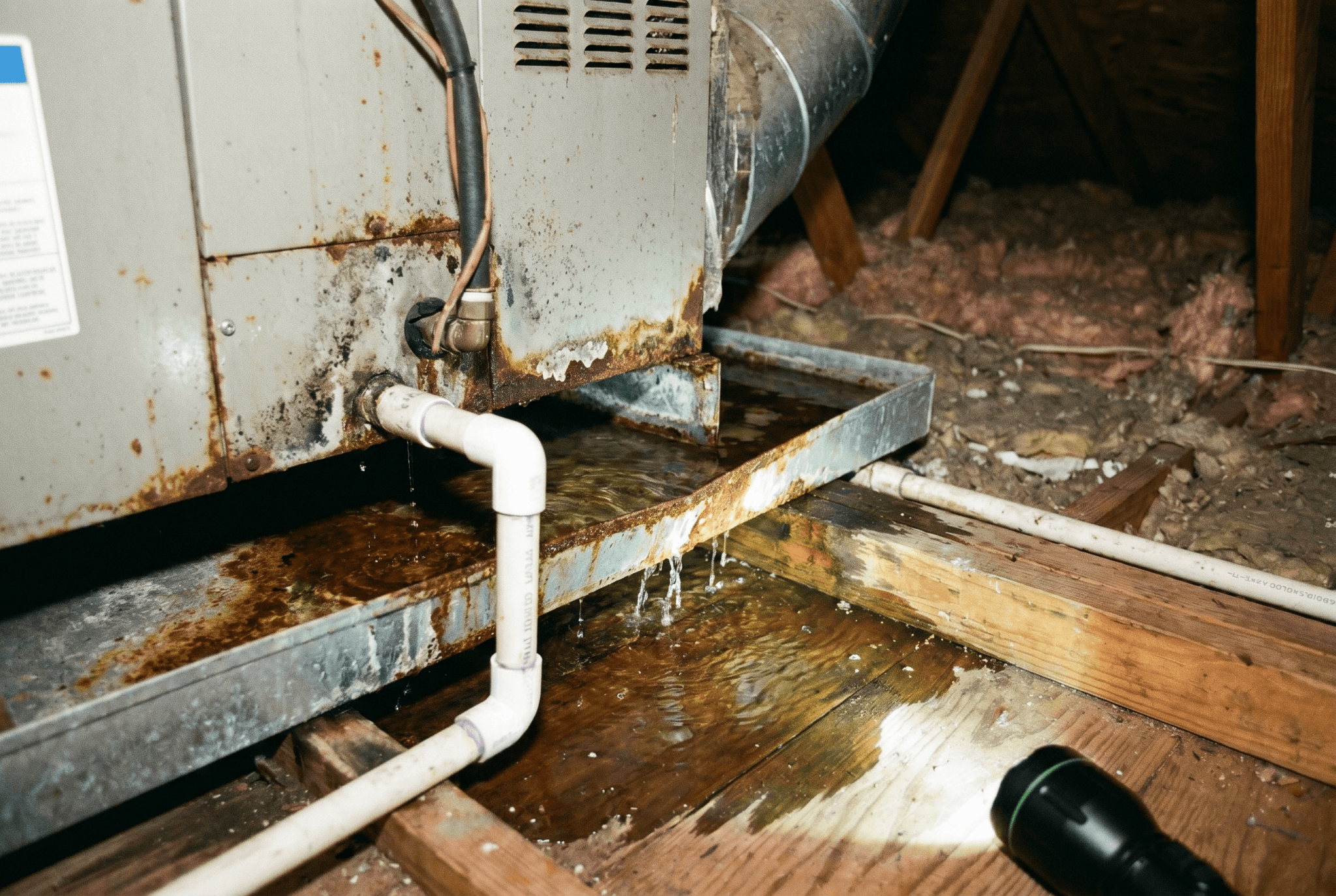
Most of these units include a secondary drain pan beneath the air handler as a backup, fitted with a float switch that should shut the system off if water rises. The problem is that these safety pans rust, crack, or sit disconnected, and float switches fail silently. When both the primary drain and the backup let you down, the overflow pours straight through the ceiling. We frequently trace AC condensate leak water damage in Irvine attics back to a backup pan that had been quietly overflowing for an entire season. This is closely related to the general moisture buildup we cover in our Attic Moisture guide, since the same attic space that traps humidity is often where the air handler lives.
In a two-story home, an attic leak can travel through the upper ceiling, run down inside a wall cavity, and emerge as staining on the first floor far from the actual source. This makes the damage harder to diagnose and often larger than it first appears, because moisture has been migrating through the structure unseen. What looks like a small spot on a downstairs ceiling can represent saturated insulation and framing two floors up.
Here is what makes a condensate leak more than a cosmetic problem. Mold needs only three things to grow: moisture, an organic food source, and time. A leaking air handler supplies all three at once. The water is constant, the paper facing on drywall and the dust in your attic are ideal food, and warm summer attic temperatures accelerate everything.
Under these conditions, mold can begin colonizing wet drywall and framing in as little as 24 to 48 hours. Because attic and ceiling leaks are hidden, that growth often has days or weeks of undisturbed time before anyone notices a stain or smells something musty. This is why a seemingly minor drip can escalate into a project requiring professional mold remediation. The combination of trapped humidity and a steady water source turns a small HVAC issue into a structural and air-quality concern with surprising speed. It is the same 60% relative humidity threshold we cover in our Summer Humidity guide to Orange County mold prevention, just delivered by a failing drain instead of coastal marine air.
You do not need to be an HVAC technician to catch most condensate problems early. A five-minute walkthrough once a month during cooling season can save you thousands in repairs. Work through these checkpoints:
Catching any one of these signs early is the difference between a simple drain cleaning and a full ceiling rebuild. Monthly checks are the single most effective defense against AC condensate leak water damage in Irvine.
Once you see a stain, the natural question is who to call first. The honest answer is that you often need both, but in a specific order depending on what you are dealing with. Here is how to tell the difference:
One clarification worth making: Water Gone Restoration does not repair air conditioners, clear condensate drain lines, or service float switches. We treat the water damage and mold that result from an AC leak, working alongside the HVAC technician who fixes the mechanical source so nothing gets missed on either side of the repair.
As an IICRC-certified restoration company, Water Gone Restoration uses professional moisture meters and thermal imaging to find exactly how far the water has traveled, which is rarely just the visible spot. We dry the structure to industry standards and document everything for your insurance claim, so the repair is done once and done right.
One detail that catches Irvine homeowners off guard is how their policy treats this kind of loss. Sudden and accidental water damage from a failed AC component is often covered, while damage from long-term neglect may not be. The way the claim is documented makes a real difference, which is why our team photographs the source, records moisture readings, and ties the damage to a specific event. If you are unsure where you stand, our insurance coordination support can help you navigate the process so a covered loss is treated as one.
Yes, an air conditioner leaking water inside your home should always be treated as a problem. A small amount of condensation on the outdoor unit is normal, but active dripping from an indoor or attic unit signals a clogged drain line, a cracked pan, or a failed float switch. Left alone, that water soaks into ceilings and walls and can breed mold within a day or two. Shut the system off, contain the water if you safely can, and have it inspected promptly.
Further than the stain suggests, almost every time. Water follows framing and gravity, so a pan overflow in the attic can run along a top plate, drop inside a wall cavity, and surface as a mark on a first-floor ceiling well away from the air handler. That is why we map the affected area with moisture meters and thermal imaging before any drying equipment is placed. Drying only the visible patch leaves wet material sitting behind the finishes.
It depends on how long the material stayed wet and how saturated it is. Drywall that was damp only briefly can often be dried in place with air movers and dehumidifiers. Drywall that has sagged, crumbled, or held water for days generally has to come out, and the insulation above it usually does too, because it holds moisture against the structure. We take readings first and open only what those readings justify.
The condensate water itself is mostly just moisture pulled from the air, so it is not highly toxic to touch. The real concern is what that water does once it sits in your home. Standing condensate collects dust, algae, and bacteria, and when it saturates drywall and insulation it quickly feeds mold growth. The resulting mold and poor air quality are the genuine health risks, especially for anyone with allergies or asthma, which is why prompt cleanup and drying matter so much.
We answer 24/7. Give us your number and a short description of the damage, and an IICRC-certified technician will call you back to schedule a moisture assessment. If it is an emergency, calling is still the fastest route.
.png)
